
How do I select the right damper actuator torque?
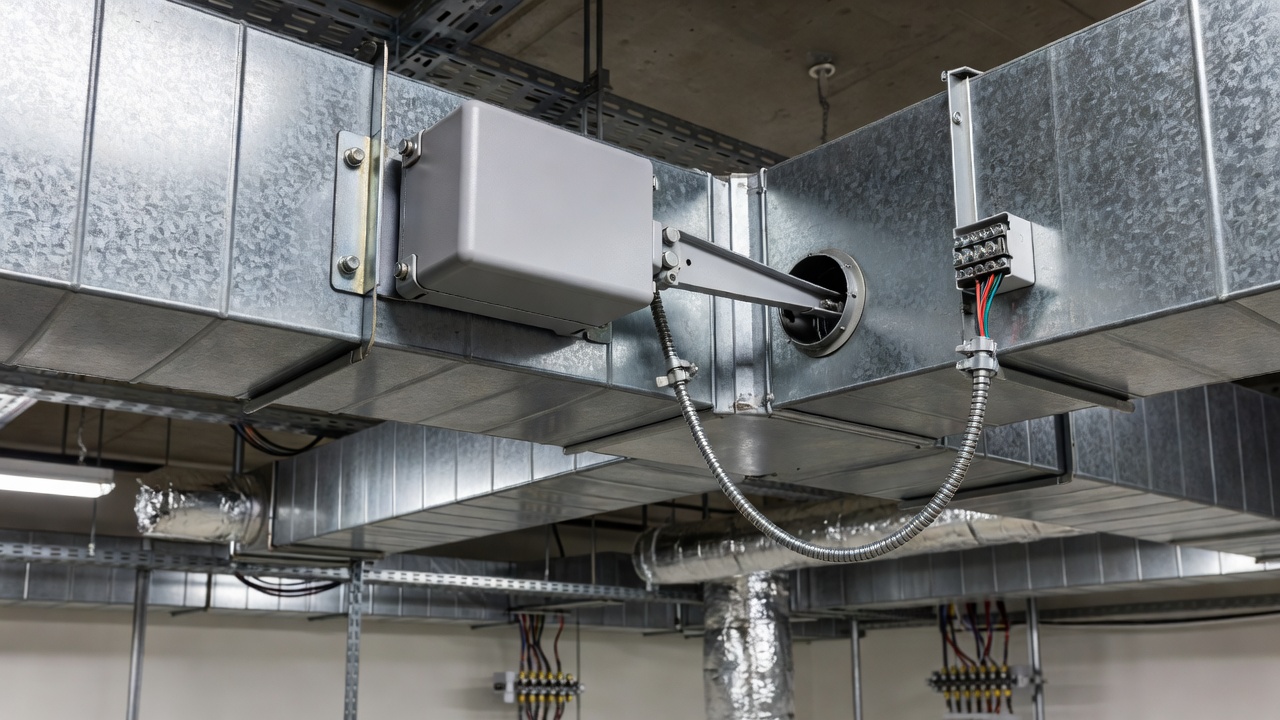
A Belimo-style modulating actuator installed on a rectangular air duct. Proper torque sizing prevents underpowered actuation at close-off conditions.
Understanding Damper Actuator Torque
Selecting the correct damper actuator torque is one of the most critical sizing decisions in HVAC controls engineering. An undersized actuator will fail to close the damper against system pressure — causing air leakage, energy waste, and potential control instability. An oversized actuator wastes capital cost and may physically damage the damper linkage or blade edges.
### The Core Calculation
Torque (N·m) = Damper Face Area (m²) × Pressure Drop (Pa) × Torque Coefficient
The torque coefficient varies by blade type:
### Why Blade Type Matters
Parallel-blade dampers have all blades rotating in the same direction. This produces a non-linear flow characteristic best suited for two-position (open/close) applications. The full aerodynamic load hits all blades simultaneously, requiring higher torque.
Opposed-blade dampers have adjacent blades rotating in opposite directions, providing linear flow modulation and lower torque requirements. They are the preferred choice for VAV economiser sections and any modulating control application.
### Safety Factors Are Not Optional
Per ASHRAE Handbook HVAC Systems and Equipment, apply a minimum safety factor of 1.2–1.5× over the calculated torque. Additional factors to consider:
### Practical Sizing Rules
- Rectangular dampers under 0.5 m²: 5 N·m minimum
### Verification Protocol
Always verify the actuator's rated torque at close-off — not just running torque. The close-off rating is the maximum differential pressure against which the actuator can fully seat the damper and hold it sealed. This value must exceed the maximum system pressure at the damper location by at least 1.5×. Use manufacturer selection software (Belimo SelectPro, Honeywell Valve & Actuator Selector) rather than manual calculation for final specification.
Actuator Torque Selection Guide
Recommended minimum actuator torque by damper area and blade type. All values include 1.3× safety factor.
| Damper Face Area | Opposed-Blade (N·m) | Parallel-Blade (N·m) | Close-off Pressure (in. w.g.) |
|---|---|---|---|
| < 0.25 m² | 4 N·m | 5 N·m | Up to 4.0 |
| 0.25–0.5 m² | 5 N·m | 8 N·m | Up to 4.0 |
| 0.5–1.0 m² | 10 N·m | 15 N·m | Up to 6.0 |
| 1.0–1.5 m² | 15 N·m | 20 N·m | Up to 6.0 |
| 1.5–2.0 m² | 20 N·m | 30 N·m | Up to 8.0 |
| 2.0–3.0 m² | 30 N·m (dual) | 40 N·m (dual) | Up to 8.0 |
| > 3.0 m² | Consult manufacturer | Consult manufacturer | Custom |
🔑 Key Takeaways
- ✓Torque (N·m) = Area (m²) × ΔP (Pa) × Coefficient (0.005–0.02)
- ✓Opposed-blade dampers need ~30–40% less torque than parallel-blade
- ✓Apply 1.2–1.5× safety factor over calculated torque
- ✓Close-off pressure rating must exceed max system pressure by ≥1.5×
- ✓Use manufacturer software (Belimo SelectPro, Honeywell Selector) for final spec