
What's the difference between parallel-blade and opposed-blade dampers?
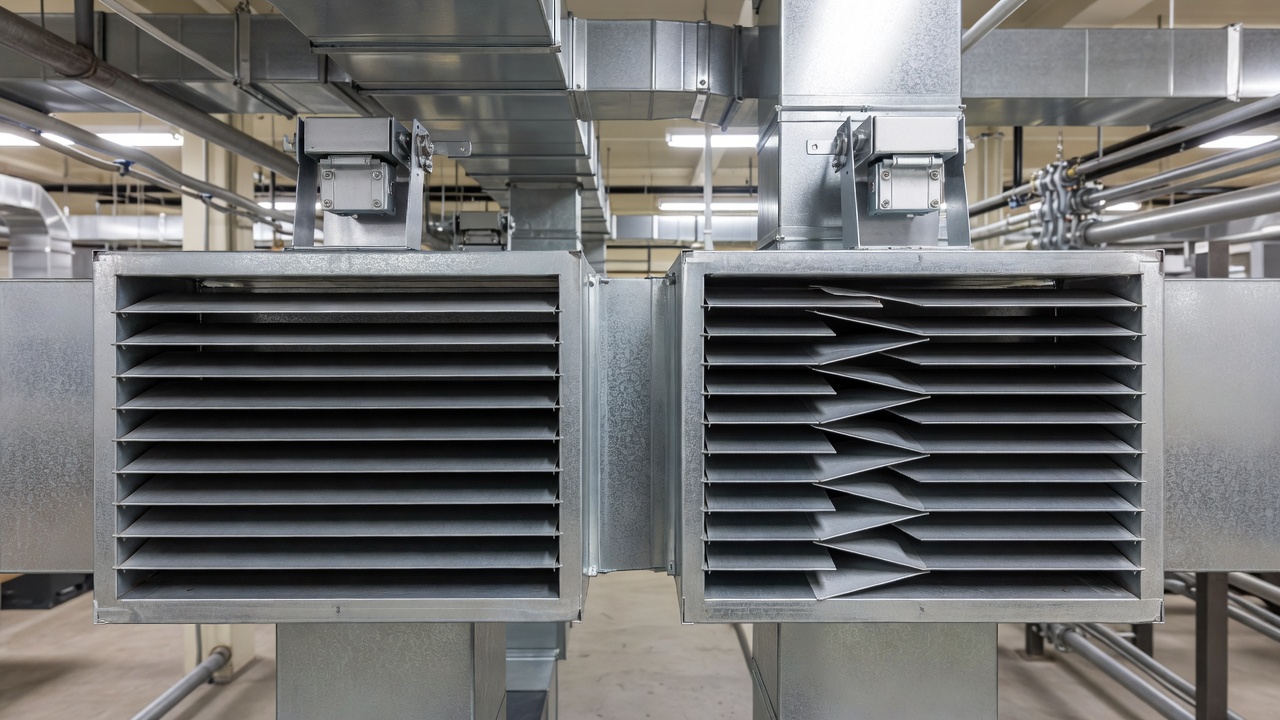
Parallel-blade (left) vs opposed-blade (right) damper configurations. Opposed-blade dampers provide linear flow modulation with ~30–40% lower torque requirements.
Blade Geometry Defines Behaviour
Parallel-blade and opposed-blade dampers may look superficially similar, but their internal blade kinematics produce fundamentally different flow characteristics. In a parallel-blade damper, every blade rotates in the same direction — much like window blinds all tilting together. This creates a non-linear relationship between blade angle and airflow: at small openings, flow changes rapidly with minor actuator movement, while at mid-to-full stroke the damper has almost no modulating effect. This characteristic makes parallel-blade dampers well-suited for two-position (open/close) isolation duty, not precision control.
In an opposed-blade damper, adjacent blades rotate in opposite directions. As one blade tilts clockwise, its neighbour tilts counterclockwise. This opposing motion produces a more linear flow characteristic across the full 0–90° stroke range. For a modulating control application — such as an air-handling unit economiser section where mixed air temperature must be precisely maintained — the opposed-blade design is strongly preferred per ASHRAE Handbook guidance.
### Torque and Aerodynamic Loading
Beyond flow linearity, blade configuration significantly affects actuator torque requirements. In a parallel-blade damper, all blades receive the full aerodynamic force of the airstream simultaneously, producing higher total torque at the actuator shaft. Opposed-blade dampers benefit from partial aerodynamic cancellation — the forces on adjacent blades partially offset each other, typically reducing total torque by 30–40% compared to an equivalent-sized parallel-blade damper for the same face area and pressure drop.
This torque difference has practical implications for actuator sizing. A 1.0 m² opposed-blade damper may require only a 10 N·m actuator, whereas a parallel-blade unit of identical dimensions could demand 15 N·m or more. On large outdoor air dampers exceeding 2 m², this torque saving can mean the difference between a single actuator and a dual-actuator jackshaft arrangement.
### Application Selection Guidelines
Use parallel-blade dampers for: fan isolation, simple on/off shutoff, low-pressure-drop bypass applications, and systems where modulating control is not required. Use opposed-blade dampers for: VAV economiser mixing sections, face-and-bypass damper arrangements, return/exhaust air balancing, and any application requiring stable, repeatable modulation. For outdoor air dampers in cold climates, the opposed-blade configuration also distributes leakage air more evenly across the damper face, reducing the risk of localised freezing on the downstream coil.
Parallel-Blade vs Opposed-Blade Damper Comparison
Key selection criteria for choosing damper blade configuration in commercial HVAC applications.
| Parameter | Parallel-Blade | Opposed-Blade | Selection Impact |
|---|---|---|---|
| Flow Characteristic | Non-linear (quick-opening) | Linear (equal-percentage) | Modulating control needs opposed-blade |
| Typical Torque Coefficient | 0.01–0.02 | 0.005–0.01 | Opposed-blade reduces actuator size by 30–40% |
| Best Application | Two-position isolation | Economiser mixing, VAV modulation | Match to control intent |
| Aerodynamic Loading | All blades see full force | Adjacent blades cancel forces | Lower torque = smaller actuator |
| Cost Premium | Baseline (lower cost) | 10–15% higher manufacturing cost | Offset by actuator savings on large dampers |
| Freeze Risk (cold climate) | Leakage concentrates at blade edges | Leakage distributed across face | Opposed-blade preferred for outdoor air |
| ASHRAE Reference | Acceptable for isolation only | Recommended for modulating | ASHRAE Handbook HVAC Systems & Equipment |
🔑 Key Takeaways
- ✓Parallel-blade dampers suit on/off isolation; opposed-blade dampers are essential for modulating control
- ✓Opposed-blade configurations reduce actuator torque requirements by 30–40% through aerodynamic cancellation
- ✓Use opposed-blade dampers for all VAV economiser mixing sections per ASHRAE guidance
- ✓Parallel-blade dampers have a non-linear flow characteristic — avoid them where stable part-load control is required
- ✓The blade configuration decision directly impacts actuator sizing, control stability, and cold-climate freeze risk